Port of Houston Bayport
Category
Service Areas
Service Area
Communities across Texas
Next Step
Request a Project Review
Category
Service Areas
Service Area
Communities across Texas
Next Step
Request a Project Review
Drayage turns are won or lost at the gate, but the building decides how fast a container becomes a pallet. We build import distribution centers, container freight stations and transload warehouses near the Bayport Container Terminal, designing the door count, the truck court and the trailer staging so a driver spends minutes, not hours, between the gate and the dock.
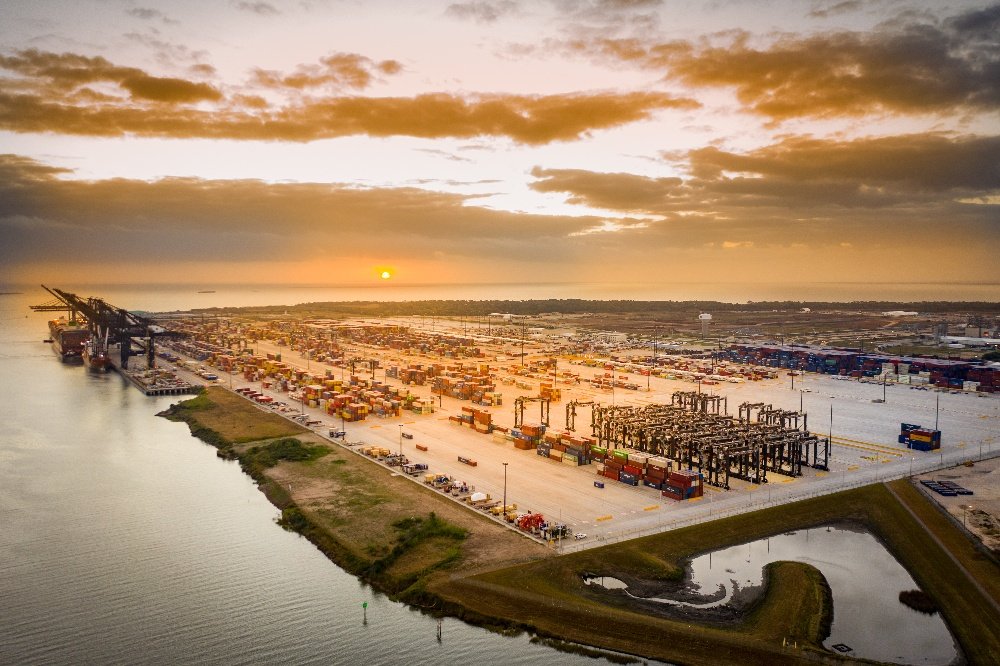
The terminal itself keeps adding capacity. Port Houston's blog described Bayport as originally designed with seven container berths and capacity for 2.3 million TEUs, on a complex that includes 376 acres of container yard and a 123-acre intermodal facility. In a January 30, 2026 release the port said it completed Wharf 7 just before the end of 2025, adding 1,000 feet of berth space and, with supporting infrastructure, more than half a million TEU of capacity. Port Houston later explained that Wharf 7 allows Bayport to work five ships at once.
That kind of growth feeds the warehouses nearby, and the building has to be ready for variable and sometimes lumpy volume.
A typical Bayport-area building handles loose and palletized freight from 40-foot containers. We lay out the dock side with doors every 12 feet to 14 feet on center, a deeper dock apron to stage chassis and containers, and a clear zone for forklifts moving between container and rack. For deconsolidation, we make the slab thick enough to take the repeated point loads of a loaded forklift working inside a container.
Many tenants want a cross-dock section for immediate transfer to outbound trucks and a rack section for storage. We build those combined buildings as a single distribution center with a single column grid, a firewall where the use groups differ and a single sprinkler system designed for the highest commodity class.
The truck court gets as much design attention as the building. Container trucks arrive with chassis, so the court needs space to drop, hook and stage chassis without blocking the through lane, and the pavement has to carry the concentrated loads of landing gear under a loaded container. We lay out the entrance with enough stacking length on the private side that a line of waiting trucks does not spill onto the public road, and we place the guard house and scale, if one is needed, where they can be used without crossing the main flow.
Port Houston stated on May 28, 2025 that the combined 25 miles of the Houston Ship Channel and Bayport Ship Channel expansion are complete, and that Bayport can accommodate larger vessels with capacities of 15,000 to 17,000 TEUs. The release also noted that Project 11 was approximately 87 percent funded as of April 2025. On January 30, 2026 the port reported 4,303,345 TEUs across its public terminals in 2025, a 4 percent increase over 2024 and a record year.
These are freight indicators, not a guarantee of lease demand at any particular site. A developer should read them as evidence that the container system is investing, and test the specific parcel against truck routes, labor and lease rates. We help with the last part by pricing different building sizes and layouts so the economics can be compared. Our Houston page covers the wider metro.
Import volume is seasonal, and tenants usually want space before the peak. That makes the delivery date the product. We work backward from the date the tenant needs to receive containers, locking the long-lead items, including dock levelers, overhead doors, switchgear and sprinkler pumps, at the contract signing, and reserving crane time for the panel erection.
A tilt-wall building of 300,000 square feet can have its shell up in a matter of weeks once the slab is complete, but the interior and the commissioning take as long as the shell. We stage inspections and the fire marshal review so they run in parallel with the final trades. The tilt-wall warehouse page explains how we sequence the casting beds, the crane picks and the roof.
The $2.1 billion that Port Houston is investing landside over the next five years, according to its infrastructure overview, is aimed at improving capacity at the public terminals. Landside improvements on the terminal side do not replace what a warehouse owner must build on the private side: the truck court, the queue lane, the trailer stalls, the dock equipment and the paving.
We usually advise clients to spend on the elements that shorten the truck's time on site. A wider apron, extra doors and a staging lane cost less than the idle time of a fleet, and the money for them comes from trimming finishes that do not change throughput. Our dock equipment and levelers page lists the specifications we use.
The primary users are third-party logistics companies, importers of consumer and industrial goods, and forwarders consolidating cargo for onward shipment. Retailers' import warehouses are also common. For each we ask for the peak container count per week, the pallet count per container and the outbound truck pattern, then size the building from those numbers.
When a tenant wants to expand later, we plan the site so a second building can rise on the same shared truck court. Neighboring Pearland has many multi-building parks that follow the same principle on a smaller scale.
Send the container count, the pallet count and the target delivery date, and we will return a building concept with a dock plan and a schedule.
Closer reduces drayage time, but the best location depends on the road network, the land price and the workforce. A site farther away with better truck access can outperform one right next to the terminal if the roads are congested. We help clients model the trade.
A common starting point is one door per 5,000 to 10,000 square feet for import work, but the right number depends on containers per day and unload time. We count both container doors and outbound truck doors and let the operator's peak week set the total.
Yes. A freight station needs a wide dock with deep staging, strong slabs for forklifts working inside containers and secured storage for customs-held freight. We coordinate the layout with the operator's customs and security requirements.
Buildings should be flexible. We use a column grid and a dock layout that allows the space to be split among several tenants, so a drop in one tenant's volume does not strand the whole building.
Growth is a positive indicator, but a warehouse project still depends on its own lease. We recommend getting tenant commitments before committing to the largest building and phasing the site so later buildings can follow demand.