Waco
Category
Service Areas
Service Area
Communities across Texas
Next Step
Request a Project Review
Category
Service Areas
Service Area
Communities across Texas
Next Step
Request a Project Review
A distributor serving both Dallas-Fort Worth and Austin can plant a warehouse halfway between them, and Waco is the point on I-35 where that logic works. We build tilt-wall and metal-framed distribution buildings, food and beverage storage and regional cross-docks in the Waco area for owners who want lower land costs than the large metros and an interstate that reaches both ends of the state's busiest corridor.
The road network is simple and useful. Interstate 35 is the major north to south highway serving Waco, US 84 is the major east to west thoroughfare, State Highway 6 runs northwest to southeast toward Bryan/College Station and Houston, and Loop 340 bypasses the city to the east and south. A truck leaving a Waco dock can run the I-35 corridor north or south, cut east on SH 6 toward the Brazos Valley and Houston, or loop around the city without entering downtown. For a regional wholesaler, that spread of routes is the main reason to be here.
Employers in the area give a sense of what kinds of buildings are needed. The 2023 county list was led by Baylor University with 3,253 employees, followed by Ascension Providence (3,075), Waco ISD (2,373), H-E-B (2,000), Baylor Scott & White Hillcrest (1,736) and Sanderson Farms (1,200). A grocery and a poultry processor in that list point to food-grade storage and cold-chain demand, while hospitals and universities generate supply-chain and records needs. We build for those users and for the cold chain and food sector specifically.
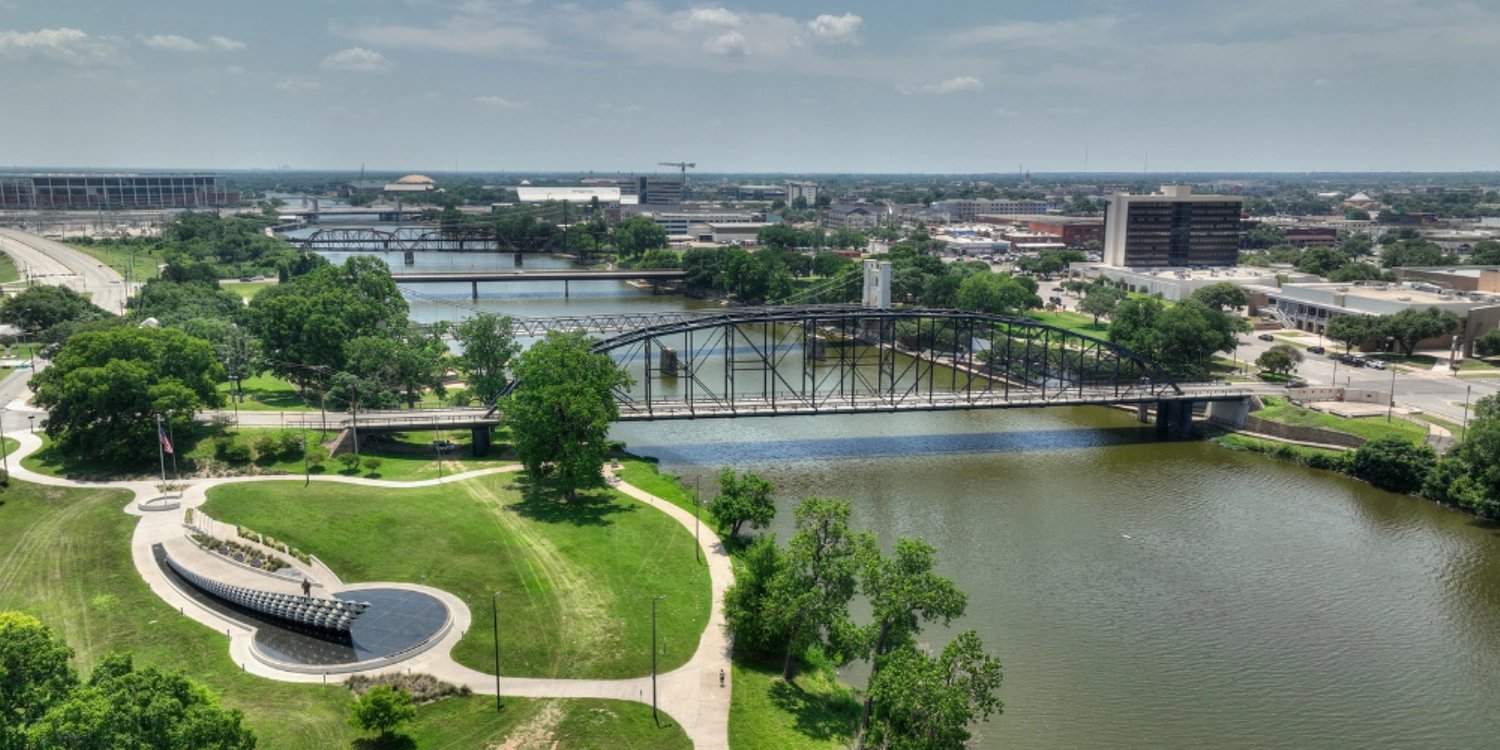
Waco sits along the Brazos River, where the 475-foot brick Waco Suspension Bridge, completed in 1870, was the first bridge to span the river, and Lake Waco is a reservoir along the city's western border. For construction the river and lake mean floodplain mapping, drainage corridors and, on some parcels, soils that vary across short distances. We pull the floodplain map and a soils report before pricing and keep the first design at a stage where it can change without cost.
The midpoint role also shapes the tenant pool. A building in Waco may serve a regional retailer's stores, a building materials supplier's contractors or a food distributor's restaurants across a wide radius. Owners benefit from the lower cost per square foot of land, but they should price the longer outbound legs to the large metros. We help with that comparison by laying out the same building near Dallas and in Waco and showing the land, site and building differences.
Waco's mid-size buildings, often 50,000 to 300,000 square feet, can be tilt-wall or pre-engineered metal. Tilt-wall offers stronger walls, higher insulation and better appearance, and it suits taller buildings and food-grade interiors. A pre-engineered metal building can win on cost and speed for lower, simpler spaces. Our work on pre-engineered metal buildings and tilt-wall buildings lets us show each option honestly.
We make the comparison with the tenant's use in mind: temperature control, security, racking height, insulation, expansion plans and the exterior the community expects. Sometimes the best answer is a hybrid, with tilt-wall at the office and dock walls and metal framing at the warehouse. We draw the options and price them so the owner can decide with numbers.
The employer list suggests several distinct tenant groups. Food and agricultural processors need sanitary finishes, drainage, washdown-rated surfaces and refrigerated storage. Healthcare systems and universities need supply storage with controlled access. Regional wholesalers need cross-dock capacity and clean truck circulation. A few buildings combine more than one use, such as a food distributor with dry storage and coolers under one roof.
For food-grade and temperature-controlled buildings, we plan insulated panels, vapor barriers, floor slabs with proper slope and drains, and refrigeration systems with appropriate redundancy. Those details are explained in our food-grade warehouse service pages. For general wholesale tenants, a straightforward distribution shell with good docks and truck access is usually the best investment.
We travel to projects across Central Texas. From Waco we serve the I-35 corridor in both directions, with projects reaching the Dallas-Fort Worth area to the north, and we coordinate with our metro teams in places such as Fort Worth when an owner has sites in both. SH 6 extends our reach toward Bryan/College Station and Houston.
The airport adds a small piece of the picture: Waco Regional Airport serves the city with daily flights to Dallas/Fort Worth International via American Eagle, which makes it practical for out-of-town owners and tenants to visit a site and return the same day. We hold project meetings on site and use video updates between visits.
Before committing to a parcel, confirm utility availability, floodplain status, soil type, zoning, truck access and the cost of any offsite work. Each of those can swing a project budget significantly, and none is visible from the street. We offer a feasibility package that covers them and provides a conceptual site plan and a preliminary budget.
It is also worth deciding early whether the building will be leased or owner-occupied, since that influences the level of finish and flexibility. Lenders and tenants often have requirements for clear height, floor load and fire protection that need to be built in from the start. If you plan to add area later, tell us now so we can protect for it in the site plan.
Tell us who the building is for and what moves through it. We will return a feasibility summary, a concept and a budget range.
It can be, if your customers lie along I-35 or toward Houston on SH 6. Land costs are lower than in the large metros, but outbound trips to those metros are longer. We compare delivered cost with a layout in Waco and one in a metro submarket.
It depends on height, insulation, appearance and budget. Tilt-wall suits taller, better-insulated and food-grade buildings. A metal building can be faster and cheaper for simple spaces. We price both for your use.
They can create floodplain restrictions, drainage requirements and variable soils. We review flood maps and soil data first and shape the building and pavement around them.
Yes. We design sanitary interiors, insulated panels, sloped drained floors and refrigeration with the equipment supplier and the tenant's quality team, then build and commission the space.
Use a common checklist: utilities, floodplain, soils, access, zoning and offsite costs. We can run it for each parcel and lay the same building on each so you can compare.