Abilene
Category
Service Areas
Service Area
Communities across Texas
Next Step
Request a Project Review
Category
Service Areas
Service Area
Communities across Texas
Next Step
Request a Project Review
Equipment staging for a gigawatt-class campus puts unusual demands on the warehouses around it. In Abilene we build laydown buildings, parts depots, electrical-gear storage and contractor supply warehouses for the trades and suppliers who serve large construction and operating sites, as well as conventional regional distribution for West Central Texas. The Stargate data center projects in Abilene are developed by a joint venture involving Blue Owl Capital, Crusoe Energy Systems and Primary Digital Infrastructure and leased to Oracle, and Larry Ellison said 10 data centers were being built there.
That is market context, not a claim of work. We do not build data centers on this site and we have no relationship with those developers. A campus of that scale generates years of demand for secure storage of switchgear, cable, cooling equipment and spare parts, and for yards where contractors can stage materials. A secondary source reports more than 6,400 workers at the local campus; as that number comes from a secondary source, treat it as an indication and confirm it with the operators. Whatever the final figure, large worker counts mean large material flows, and those flows need buildings.
Our data center knowledge in slabs, electrical rooms and secure perimeters helps when a supplier needs a storage building that matches the standards of the campus it serves.
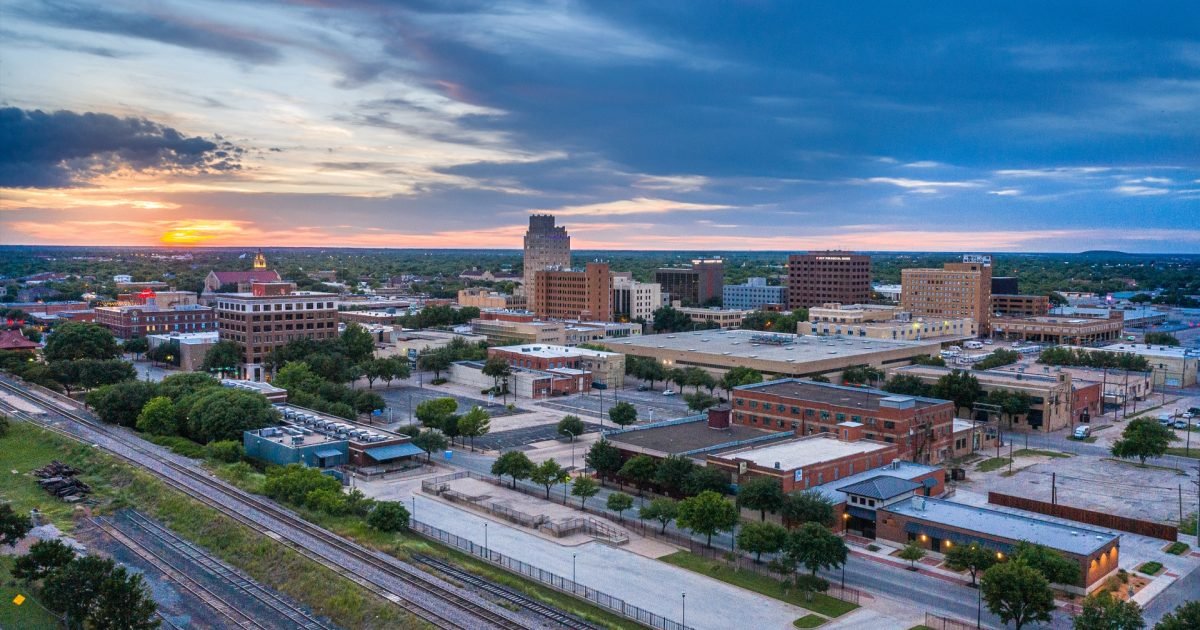
Interstate 20 forms a loop along Abilene's northern side between exits 279 and 292. U.S. 83, U.S. 84 and U.S. 277 also pass through the city, and Loop 322 runs on the east side. The former Texas and Pacific Railway, now part of the Union Pacific mainline, divides Abilene into north and south zones. For a truck, the loop and the interstate are the main routes. For a site planner, the railway is a constraint: crossings are limited, and a parcel on the wrong side of the tracks may add miles to a delivery route.
We ask for a route study on every candidate site: where the loaded trailer enters the interstate, how many grade crossings it touches and what happens when a train blocks one. A parcel on the I-20 side with a direct interchange is worth more to a distribution user than a cheaper parcel across the tracks. Our truck court and trailer yard design includes space for trailers to stage without blocking the public road.
The buildings we plan for Abilene suppliers fall into three groups. The first is a secure storage warehouse for electrical gear and sensitive equipment, with a high-clearance dock, a heavy slab and controlled access. The second is a contractor supply building with open yard space, a covered loading area and a counter. The third is a regional distribution warehouse for food, building products and consumer goods serving Abilene and surrounding counties.
A high-bay crane-ready building suits the first group, since an overhead crane lets crews move heavy equipment without relying on rented forklifts. We design the frame and the foundations for the crane loads from the outset.
Dyess Air Force Base on Abilene's west side is the top employer with 8,864 employees in the city's 2024 report, followed by Hendrick Health System (2,896) and Abilene ISD (2,500). Those three tell us about steady demand for supplies, medical goods, school and base operations. A medical-supply distributor, a food wholesaler and a building products supplier each need a different building, and we match the shell to the user.
For logistics and 3PL operators looking to serve West Central Texas, Abilene is a practical hub: it sits on I-20 between the Dallas-Fort Worth and Permian Basin markets. We build 3PL buildings with flexible racking space, multiple dock doors and expansion room, so the operator can add customers without moving.
Projects tied to large energy users face a different utility conversation than a typical warehouse. ERCOT serves about 90 percent of the state's electric load. Texas Senate Bill 6 directs the Public Utility Commission to adopt standards for interconnecting large load customers at a 75-megawatt threshold. A warehouse does not approach that number, but a supplier building next to a large campus should ask the serving utility about capacity and lead times early.
We also follow the state building framework: the International Building Code, with local amendments adopted by ordinance. For wind and hail, we discuss roof system choices with the owner and insurer.
West Texas sites are open and often windy, dusty and hard. We schedule, supervise and inspect grading, caliche or select-fill pads, paving and slab placement, and we control dust and runoff during earthwork. For tilt-up buildings we cast panels on the slab, brace them, and schedule lifts for calm mornings. Owning the concrete and the lift sequence means that a weather delay is a decision we make, not a surprise handed down from a subcontractor.
The slab is the key to a storage building. For heavy electrical gear and cable reels, we engineer a floor with reinforcing and thickness matched to the point loads, and we protect the dock apron where trailers land. We coordinate roof, door and dock equipment so that the building is weathertight before the interior trades start. Our build-to-suit warehouse process shows how those steps tie to the tenant's equipment list.
For laydown and storage buildings, the big lines are site preparation, the slab, the structure and the yard paving. A large yard with crushed stone or concrete paving can cost as much as the building on a small footprint, so we recommend deciding early how much of the yard needs hard surface. Fencing, lighting and security systems also add up when the stored equipment is valuable.
We give owners a base price and options: a taller clear height, a crane, a fire protection upgrade, a larger yard. Each has a cost and a benefit, and the owner chooses.
When a large campus is under construction, local crews, concrete suppliers and cranes can be fully booked. We secure resources early, give our concrete suppliers firm pour dates and keep a weekly look-ahead so the owner sees conflicts before they hit the schedule. In West Texas wind can limit crane lifts, so we plan tilt-up lift days with contingency and monitor forecasts.
Owners who are also looking at other West Central Texas options can compare costs and timing with Wichita Falls, where the base and the regional hospital drive demand, or with Tyler in East Texas.
Send us the parcel, the equipment or product and the date you need the building ready. We will return a layout, a schedule and a budget range.
Yes. We design secure, heavy-slab buildings with controlled access and high-clearance docks. The detailed requirements come from the equipment maker and the owner, and we build to them.
It splits the city, and crossings can add delay. We study routes from each parcel to I-20 and check crossings, so the building sits where trucks can move reliably.
For regional distribution, it is a practical one: I-20 runs along the northern side and four U.S. highways cross the city. We help operators compare it against other cities by cost and truck access.
With caution. The number we saw came from a secondary source, and we recommend confirming it with the operators before relying on it in a business case.
A heavier gauge metal or a reinforced membrane with a good attachment pattern. We price options and suggest discussing them with the insurer.