Truck Court and Trailer Yard Construction
Category
Warehouse Construction Services
Service Area
Communities across Texas
Next Step
Request a Project Review
Category
Warehouse Construction Services
Service Area
Communities across Texas
Next Step
Request a Project Review
Rain decides the truck court. A building can be square, plumb and on schedule, and the yard around it will still hold standing water, rut under the first loaded trailers and flood the dock pits if the grading, the pavement section and the drainage were treated as an afterthought. In El Paso, a 2006 storm dropped a year's worth of rain in two days and caused more than $200 million in damage to homes and businesses and $115 million to the city's stormwater system. Arid does not mean safe.
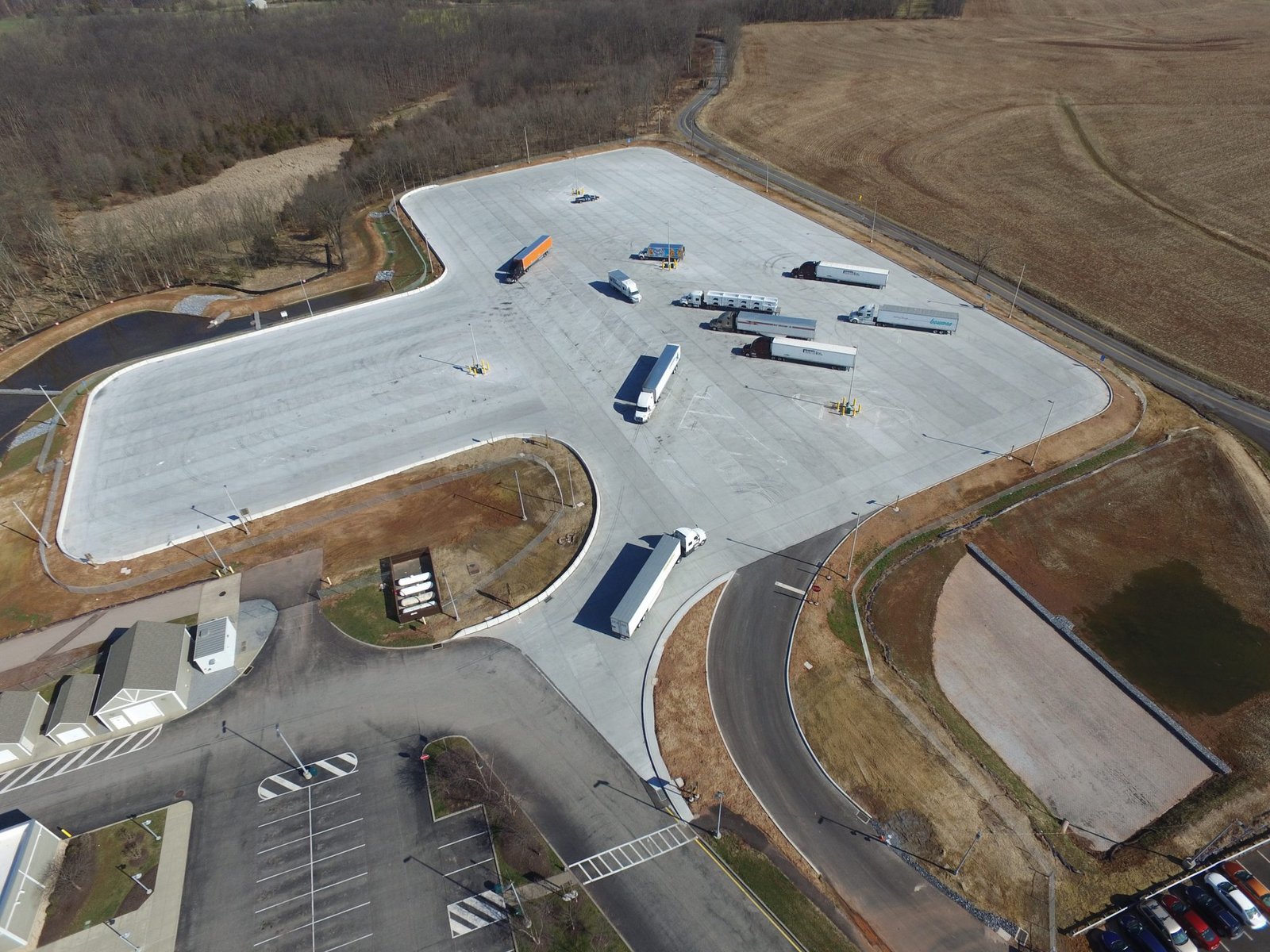
The truck court is the part of a warehouse that takes the most abuse. Loaded tractor-trailers turn, brake and park on it all day, trailer landing gear punches into the surface, and diesel and tire wear degrade asphalt. Concrete pavement is the usual answer for heavy courts and dolly pads, and it has to be designed as a pavement: subgrade, base, thickness, joints and drainage together.
We design and build truck courts and trailer yards for distribution centers, cross-docks and logistics parks across Texas, and we treat the yard as a structural element.
Different parts of the state ask for different yards. Conroe's northern industrial park lists four-lane concrete streets with city water and sewer across 1,655 acres, which tells you what the truck traffic expects: concrete from the property line to the dock. In Laredo, a 3,314-acre industrial park recently won federal authorization for a 2.6-mile short-line railroad that would link about 1,900 rail-served acres to the main line, so yards there may combine trailer parking, rail-served storage and container staging.
Near the coast and along the major rivers, the flood plan is the starting point for grade. Texas produced its first state flood plan from 15 regional plans, and the engineering that sits behind them is useful when we set pad elevations for the Laredo or El Paso markets and for coastal parcels alike.
We place the subgrade, the stabilized base, the reinforcement and the concrete on the truck courts we manage. That includes dowelled contraction joints, edge thickening at the apron and the dolly pads where trailer landing gear parks. Because the same crews pour the building slab, they understand how the apron meets the dock pits and how the joints line up with the dock layout.
Grading is the part of the job owners underestimate. We set the apron to slope away from the dock at a gradient that sheds water without making trailers lean, and we shape the court so water leaves through inlets, trench drains or swales that the civil engineer has sized. A well-built court needs few repairs in the first ten years, and a poorly drained one needs them in the first two.
The two biggest variables are thickness and area. A court that serves 100 trailer positions needs a lot of concrete, and every added inch of thickness adds yardage and cost. We design the section for the expected truck count, the weight and the subgrade strength, and we use thicker sections only where the load demands it: dock aprons, turning areas and entrances.
The next lever is trailer parking. Operators often ask for more positions than the site can fit, or fewer than their growth plan needs. We test parking counts against the lease requirements, the zoning rules and the stormwater plan. If a site is tight, we can look at more efficient layouts, but the numbers must be consistent with the site utilities package and the detention plan. Pavement is also where value engineering goes wrong most often. Thinning a section saves money in the bid and costs more in repairs, so we show owners the life-cycle effect of each option before they choose.
A truck court is a traffic system, and safety follows from its geometry. Turning radii must fit the longest trailers the operator will receive. Entrances need stacking distance so queued trucks do not block the public street. Pedestrian paths, employee parking and fire lanes need to be separated from truck routes, and lighting needs to cover the apron and the trailer stalls.
Fire access is another requirement. The fire marshal reviews hydrant locations, lane widths and turning space around the building, and we coordinate the site plan with that review. The dock equipment and levelers package ties in at the apron, so we plan the two together. Security rounds out the list: gates, fencing, guard booths and license-plate cameras all sit at the entrance, and each needs conduit and a slab pad that is easier to include in the first pour than to cut in later.
The truck court serves the building's function, so it connects directly to what happens inside. A distribution center needs trailer positions in the right ratio to its doors, and a truck terminal needs a yard sized for staged trailers as well as doors. We work from the operator's turn counts to set both.
Developers weigh these decisions in their pro formas, and our note for developers and REITs describes how we price yards at the concept stage. The earlier we see the site plan, the better we can advise on the parking count and the pavement section.
Send the site plan, the expected truck count and the soils report. We will return a pavement section, a drainage approach and a price.
Concrete is the usual choice for dock aprons and heavy-traffic areas because it resists rutting under loaded trailers and landing gear. Asphalt can work for lighter-duty parking and drive lanes. We price both, and many sites use concrete at the dock and asphalt farther out.
The thickness depends on the truck count, the axle loads and the subgrade. Heavy truck courts commonly run thicker than ordinary parking lots, and the dock apron is thicker still. The civil and geotechnical engineers set the numbers, and we price the section they design.
Start with the operator's plan: how many trailers are on site at peak, how many are dropped, and how many are staged. The zoning code and the site area may limit the count, so we test the plan against both. Extra positions are cheaper to build at the start than to add later.
We grade the apron to shed water away from the building, size the inlets and trench drains with the civil engineer, and check the grades during the pour. After the first heavy rain, we walk the court with the owner to look for any ponding that needs correction.
Yes. We can build the first phase of the court with the building and leave pads and utilities for the second phase. The key is to design the drainage and the pavement edges to accept the extension without rework.