Building Products Distribution Warehouse Construction
Category
Industries We Serve
Service Area
Communities across Texas
Next Step
Request a Project Review
Category
Industries We Serve
Service Area
Communities across Texas
Next Step
Request a Project Review
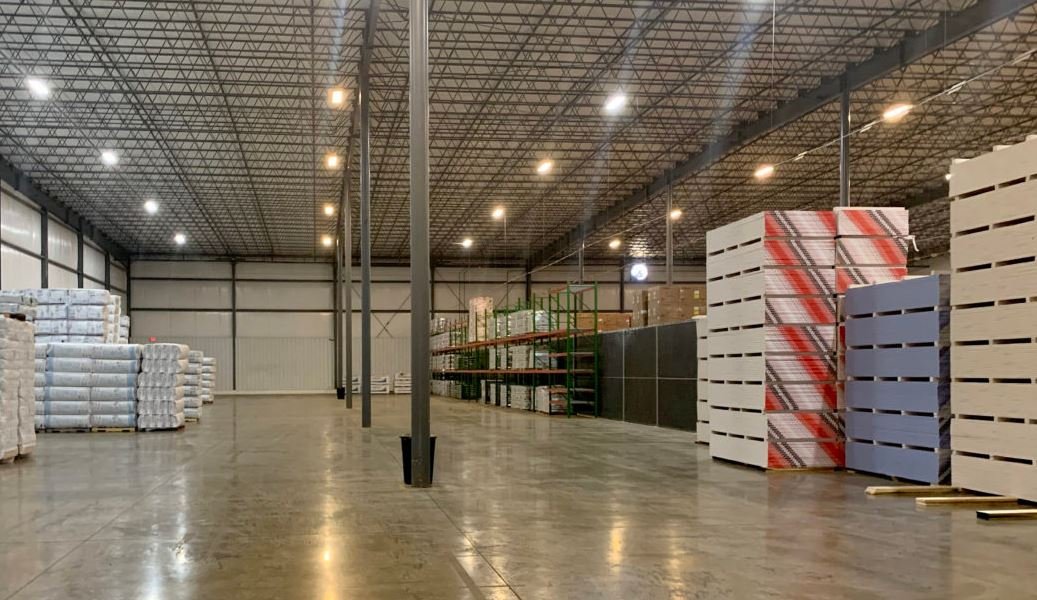
Wallboard weighs far more per cubic foot than apparel, and lumber, pipe, roofing, tile and cabinets each load a building in their own way. Building products distributors sell to contractors who show up at 6 a.m. with a flatbed, so the buildings that serve them need loading lanes, covered storage and floors that can take a loaded forklift turning on a point. That is a different design problem from a retail DC with its racked cartons.
A typical distributor runs two businesses in one site: a will-call counter and yard for local contractors, and a warehouse that feeds delivery trucks and branch transfers. Product ranges from bulky items stored outdoors under canopies to higher-value goods that need a dry, secure building. We shape the site accordingly, putting the yard, canopy, rack and counter in the order that customers and trucks will meet them.
Demand follows construction, and construction in Texas follows growth. When Grand Prairie annexed nearly 900 acres on its southern boundary in 2025 for the Goodland master-planned community, the annexation was a data point for distributors watching where subdivisions will rise. Our Grand Prairie work is typical of how we track that movement.
Building products yards sit on large paved areas that carry heavy point loads, and Texas soils make that a geotechnical issue. A University of Texas at Austin report prepared with TxDOT and the Federal Highway Administration describes three methods for calculating the potential vertical rise of expansive clays, including TxDOT's Tex-124-E and two UT methods based on centrifuge swell tests. We use that framing when reading a geotechnical report: if the predicted rise is high, the owner can choose between moisture conditioning, lime or cement treatment, a thicker pavement section or a stiffened slab.
Permits follow the municipality. Texas law makes the International Building Code the commercial code for cities, with local amendments by ordinance, so a canopy or open-sided storage structure may be reviewed differently from city to city, particularly for wind and fire separation. Stormwater is the bigger approval item for yard-heavy sites, since the impervious area is large. We prepare detention and drainage design in parallel with building drawings so one does not hold the other up.
The building is only part of the facility. We plan the yard first: where long-length products like pipe and lumber are stored, where trucks load without blocking the entrance, and how a customer's pickup can leave while a delivery truck arrives. Canopies and open-sided sheds shelter product from rain and sun, and their wind and hail resistance matter in Texas, where 2024 saw 878 hail events and 169 tornadoes.
Inside, will-call counters and showrooms should be near the entrance and separate from forklift traffic. Racking plans vary: cantilever racks for long goods, pallet racks for boxed items and floor-loaded zones for heavy products like tile and brick. We ask for the heaviest pallet, the typical forklift and the number of daily lift cycles so we can set slab thickness, reinforcement and joint design. The same site thinking applies to truck courts and trailer yards, where pavement sections follow the traffic.
The most important surface on a building products site is the one under the wheels. We coordinate the trade partners who place and finish industrial concrete floors and heavy-duty yard paving, and we control the subgrade preparation, reinforcement placement, pour sequence and curing. Joint layout matters for forklifts with hard wheels, and a poorly laid joint pattern will spall under traffic. We cut and fill joints on schedule, not as an afterthought.
We also manage the structural trade partners closely. A tilt-wall warehouse gives a durable, secure envelope for goods that need protection. For canopies, drive-through loading sheds and lower-cost storage, a pre-engineered metal building may be the right choice, and we can combine the two on one site. Because we control both, we can compare options honestly and suggest the cheaper one when it will do.
Contractor demand in Texas does not take the winter off, but spring and summer are busy, and distributors want to be open before those months. We schedule the yard paving and slab so that product can be stocked ahead of the busy season, and we plan the sequencing of site work so that a branch can open the counter and one storage bay while another bay is still being completed.
Weather is the main schedule risk. Concrete and paving work depends on dry conditions, and a rainy month can push a yard back by weeks. We keep float in the paving schedule, sequence the building first so that interior work proceeds in any weather, and have a plan for temporary construction entrances that does not disrupt a neighboring branch. In wet clay areas, we monitor subgrade moisture before paving, because a rushed pour on wet soil is the most expensive kind of schedule saving.
A full-line distributor of roofing and lumber often wants a mix: a warehouse for boxed and sensitive goods, an open canopy for long goods and a paved yard. A tile or flooring distributor wants a warehouse with a showroom, tight dock control and floor-loaded storage. A distributor that sells through home centers and dealers shares dock and trailer needs with retail distribution. A plumbing or electrical wholesaler wants a counter-driven branch with narrow aisles and a delivery fleet staging area. The buildings overlap but the site plans differ.
In the Houston area, industrial parks provide examples of the range. In Katy, a developer began construction in December 2019 on a 433,300-square-foot building at the Grand Parkway and Clay Road, with plans for five buildings from 165,100 to 433,200 square feet across about 78 acres. Reports also say parts of the Katy area sank about 14 inches between 2007 and 2025, a reminder that subsidence is part of site planning in the region.
Distributors typically combine several scopes. Dock equipment is needed where trucks unload pallets, and we select levelers and seals for the mix of flatbed, box truck and tractor-trailer traffic. Dock equipment and levelers are often paired with ground-level doors for forklifts that drive trucks directly. Site utilities and stormwater work are the other large piece.
Water policy is moving too. Texas voters approved Proposition 4 in November 2025, directing up to $1 billion a year from existing sales tax revenue, starting in 2027, to water supply projects, a program of about $20 billion over two decades. Pipe, valves, fittings and fixtures are the products many of our distributor clients stock, so a long pipeline of public water work is a possible source of demand for them. Related distributors in manufacturing and distribution often share the same site design concerns.
Tell us the heaviest product, the length of the longest items, the number of daily customer visits and the date the branch has to open. We will return a site plan, a structure recommendation and an estimate for building, yard and canopy.
It depends on the heaviest loads, the forklift and the soil. Thicknesses are chosen by design, not by rule of thumb, and heavy products like tile or brick on pallets with large forklifts call for stronger sections than a light warehouse. We ask for pallet weights, equipment specs and the geotechnical report, then design the slab and joints for those loads.
Per square foot of storage, yes. Canopies and open-sided sheds cost less than enclosed buildings, but they offer less security, and some products, such as drywall or cabinets, must stay dry. Many sites combine a closed warehouse for sensitive goods with canopies for lumber and pipe. We price the mix against product value and insurance conditions.
They move with moisture, which can crack pavement and lift slabs. The risk depends on the soil, the drainage and how the surface is sealed. A geotechnical report tells us the potential vertical rise, and treatments range from moisture conditioning to chemical stabilization to a thicker section. We choose by cost and risk, not by reflex.
Often, with planning. We separate the work area from customer routes with fencing, schedule deliveries of materials outside peak counter hours and phase utility tie-ins for slow periods. The branch should know which days will be noisy and which parking is affected. For yard paving, we work in sections, so trucks can load from the open half.
Ask who prepares the drainage design, how detention is sized and whether the approval will be submitted before or with the building permit. Yards are large impervious areas, and a municipality may require detention or water quality measures. We coordinate with civil engineers early so these items do not become the last open permit.